

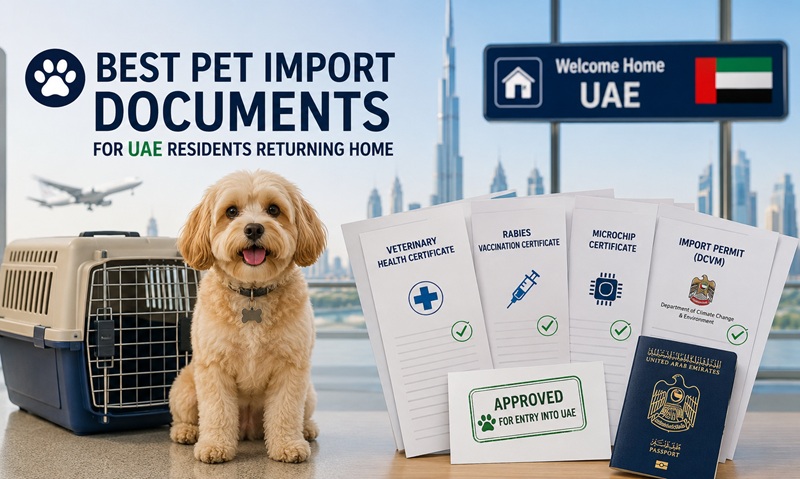
You’ve been living abroad, and now it’s time to bring your pet back to the UAE. Whether you’re a returning expat or a UAE national coming back from years overseas, the UAE pet import process has specific requirements that catch many people off guard. Miss one document, and your dog or cat could be held at Dubai or Abu Dhabi airport — sometimes for days.
Here’s what you actually need, in the right order.
Why UAE Pet Import Documents Are Stricter Than You Might Expect
The UAE follows guidelines set by the Ministry of Climate Change and Environment (MOCCAE), and they’ve tightened import rules in recent years. Animals arriving without proper documentation aren’t just delayed — they can be sent back to the country of origin at the owner’s cost.
The good news? The process is manageable with the right preparation.
Required Pet Import Documents for UAE Entry
1. ISO Microchip Certificate
Your pet must have a 15-digit ISO-compliant microchip (standard 11784/11785). This is non-negotiable. Keep the original microchip certificate — the chip number must match every other document exactly.
2. Valid Rabies Vaccination Certificate
- Must be administered after microchipping (vaccination before microchip = invalid)
- Must be current — not expired at the time of travel
- Rabies vaccination must be given at least 30 days before travel (but not more than 12 months ago for dogs; 3 years for cats with approved multi-year vaccines)
3. Official Veterinary Health Certificate
This is the most time-sensitive document. It must be:
- Issued by a government-accredited veterinarian
- Endorsed by your country’s national veterinary authority (e.g., USDA APHIS in the USA, APHA in the UK)
- Valid for 10 days from the date of signing — book your vet appointment accordingly
4. Import Permit from MOCCAE
For most animals, you need a UAE import permit obtained before travel. Apply through the MOCCAE website or the UAE’s integrated environment portal. Processing takes 3–7 business days.
5. Rabies Antibody Titer Test (RNATT) — Conditional
Required if you’re coming from a country not on the UAE’s “approved” list. The test must be done at an approved lab and show a reading of ≥0.5 IU/ml. The result must be at least 3 months old but no older than 24 months.
6. Treatment Records for Tapeworm and External Parasites
Depending on the origin country, your vet may need to certify that your pet has been treated for tapeworm (Echinococcus) within 1–5 days of travel, and for fleas/ticks within 30 days.
Document Checklist Summary
| Document | Who Issues It | Timing |
|---|---|---|
| Microchip certificate | Your vet | Before all other docs |
| Rabies vaccination record | Your vet | 30+ days before travel |
| Veterinary health certificate | Accredited vet + government endorsement | Within 10 days of travel |
| UAE import permit | MOCCAE | Apply 7–14 days before travel |
| Titer test result | Approved lab | 3 months–24 months old |
| Parasite treatment cert | Your vet | Within 1–30 days of travel |
Expert Insight: What UAE Airport Vets Check First
When your pet arrives at Dubai or Abu Dhabi, the airport veterinary team will scan the microchip first. If it doesn’t match the number on your health certificate, the process stops immediately. Double-check every document has the exact same 15-digit chip number before you travel.
Common Mistakes UAE Returnees Make
- Getting the health certificate too early — It expires in 10 days. Don’t sign it two weeks before your flight.
- Not getting government endorsement — A vet-signed health certificate alone isn’t enough. The USDA, APHA, or equivalent authority must endorse it.
- Skipping the import permit — Some owners assume they can sort it on arrival. You cannot.
- Wrong titer test lab — The UAE only accepts results from OIE-approved laboratories. Check the list on MOCCAE’s website before booking.
Pro Tips for a Smoother UAE Pet Import
- Apply for the MOCCAE import permit as soon as your travel dates are confirmed.
- Keep digital and physical copies of all documents — carry originals in a clearly labeled folder.
- Call MOCCAE (+971-800-5544) to verbally confirm your paperwork 48 hours before flying.
- Use a UAE-based pet relocation agent (several operate out of Dubai) for high-value or anxious animals.
FAQs: UAE Pet Import Documents
Q: Can I bring my cat or dog to the UAE without a titer test? If you’re arriving from a low-rabies-risk country on MOCCAE’s approved list, you may be exempt. Check the latest approved country list on the MOCCAE website, as it’s updated periodically.
Q: How many pets can I bring into the UAE at once? Generally, you can bring up to 2 pets per passenger. More than 2 requires special permits and often cargo arrangements.
Q: Are exotic pets allowed into the UAE? The UAE has a separate list of prohibited animals. Exotic cats, primates, and certain reptiles are generally not permitted as pets. Always verify with MOCCAE before attempting to import an unusual animal.
Q: How long does the UAE import permit take? Typically 3–7 business days through the MOCCAE portal. Apply at least two weeks before travel to give yourself buffer time.
Q: What happens if my pet is rejected at the border? The animal will be kept in a government facility at your expense and either returned to the origin country or placed in quarantine. This is why getting documentation right before you fly is essential.
Conclusion
Returning to the UAE with a pet is absolutely manageable — but it’s not forgiving of shortcuts. Get the import permit early, time your health certificate carefully, double-check that microchip number on every document, and make sure your titer test comes from an OIE-approved lab. Follow this checklist from start to finish, and your pet should clear UAE customs without issue.
Start your application at the official MOCCAE portal and confirm requirements directly, as rules are updated regularly.